Troy
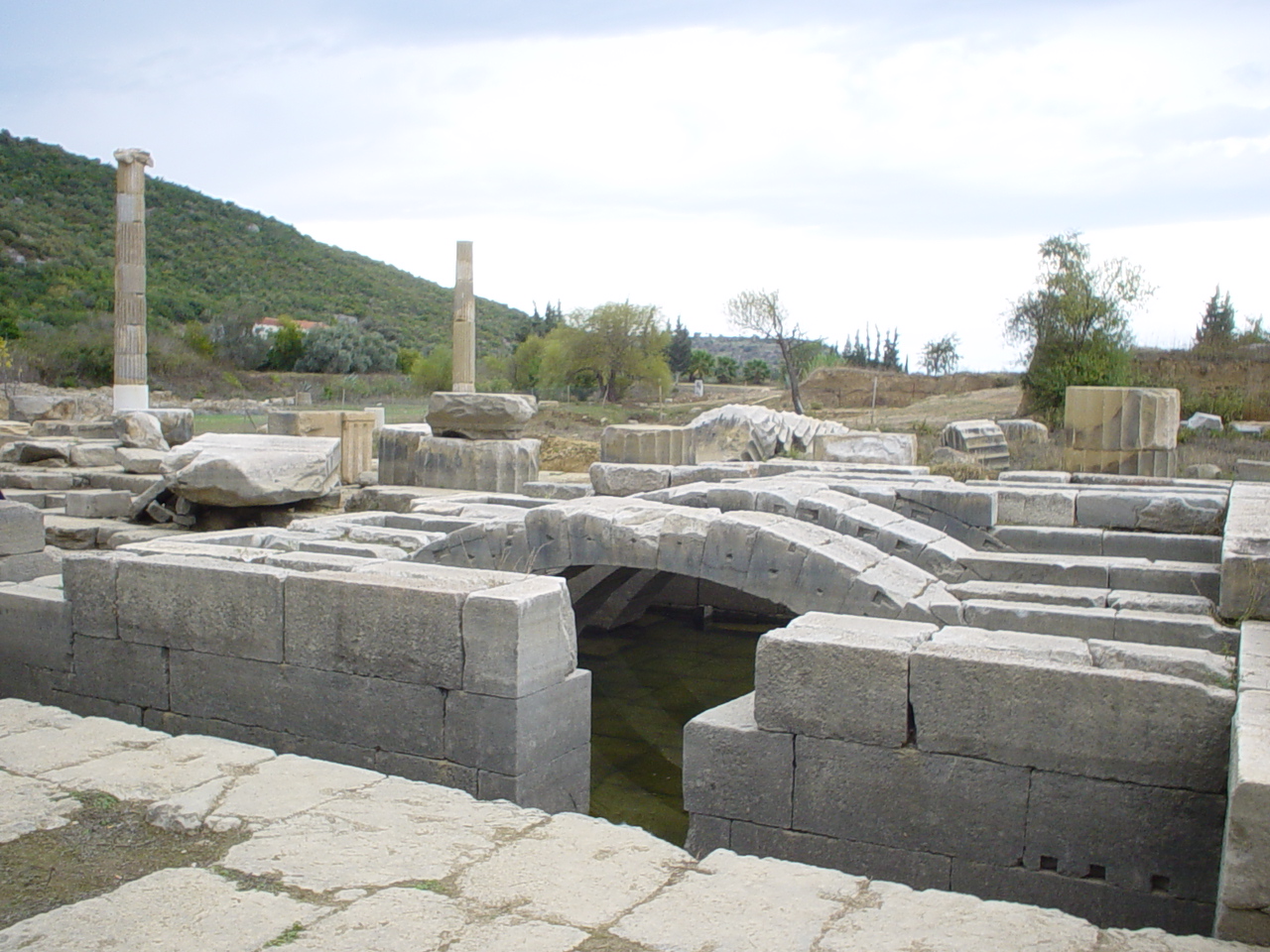
Hadrianic Odeon in Troy IX, small Theatre renovated by Hadrian in 124 AD.
In th…
Identifier: ilioscitycountry1880schl (find matches)Title: Ilios : the city and …
An der Stadtmauer von Troja
Troy (Ilion), Turkey
+20
0
Canakkale

Troy

Also known as: Truva, Troya, Çanakkale

A city otherwise know as Illion

Wiki 188 km from Izmir

Directions use browser geolocation, approximate to 1-2 km. Privacy policy.

At a glance

Troy is a Bronze Age archaeological site in Turkey. It is located in Canakkale, in the Aegean Coast region. The nearest major city is Izmir, approximately 188 km away. Artefacts from this site can be seen at the Troy Museum. There are 2 other archaeological sites within 25 km, including Achilleion.

About this site

Troy (Greek: Τροία) or Ilion (Greek: Ίλιον) was an ancient city located at Hisarlik in present-day Turkey, 30 kilometres (19 mi) south-west of Çanakkale and about 6 kilometres (4 mi) miles east of the Aegean Sea. It is known as the setting for the Greek myth of the Trojan War. In Ancient Greek literature, Troy is portrayed as a powerful kingdom of the Heroic Age, a mythic era when monsters roamed the earth and gods interacted directly with humans. The city was said to have ruled the Troad until the Trojan War led to its complete destruction at the hands of the Greeks. The story of its destruction was one of the cornerstones of Greek mythology and literature, featuring prominently in the Iliad and the Odyssey, and referenced numerous other poems and plays. Its legacy played a large role in Greek society, with many prominent families claiming descent from those who had fought there. In the Archaic era, a new city was built at the site where legendary Troy was believed to have stood. In the Classical era, this city became a tourist destination, where visitors would leave offerings to the legendary heroes. Until the late 19th century, scholars regarded the Trojan War as entirely legendary. However, starting in 1871, Heinrich Schliemann and Frank Calvert excavated the site of the classical era city, under whose ruins they found the remains of numerous earlier settlements. Several of these layers resemble literary depictions of Troy, leading some scholars to conclude that there is a kernel of truth to the legends. Subsequent excavations by others have added to the modern understanding of the site, though the exact relationship between myth and reality remains unclear. The archaeological site of Troy consists of nine major layers, the earliest dating from the Early Bronze Age, the latest from the Byzantine era. Each of these layers has sublayers for a total of 46 strata. The mythic city is typically identified with one of the Late Bronze Age layers, such as Troy VI, Troy VIIa, or Troy VIIb. The archaeological site is open to the public as a tourist destination, and was added to the UNESCO World Heritage list in 1998.

Text sourced from Wikipedia under CC BY-SA 4.0. Read more on Wikipedia →

Location

39.9586, 26.2387
Open in Google Maps

Related Museums

Museums with artefacts or exhibits from Troy.

Troy Museum
Tevfikiye Köyü, 17100 Merkez/Çanakkale, Turkey
0 km from site

Nearby Sites

2 sites within a short drive — closest is Achilleion at 9 km. The Aegean Coast has 44 sites in total.

Achilleion 9 km
Achilleion
Ezine
Alexandria Troas 24 km
Alexandria Troas
Çanakkale
Neandreia 26 km
Neandreia
Çanakkale
Assos 53 km
Assos
Canakkale
Atarneus 113 km
Atarneus
Dikili
Saved! Find it in your list

Saved Sites

Saved only on this device. Your list is stored in your browser — not in a database, and there is no account or login. It will be lost if you clear your browser data or switch to a different device or browser. Use Share this list to save a permanent link you can reopen anywhere.