About this site
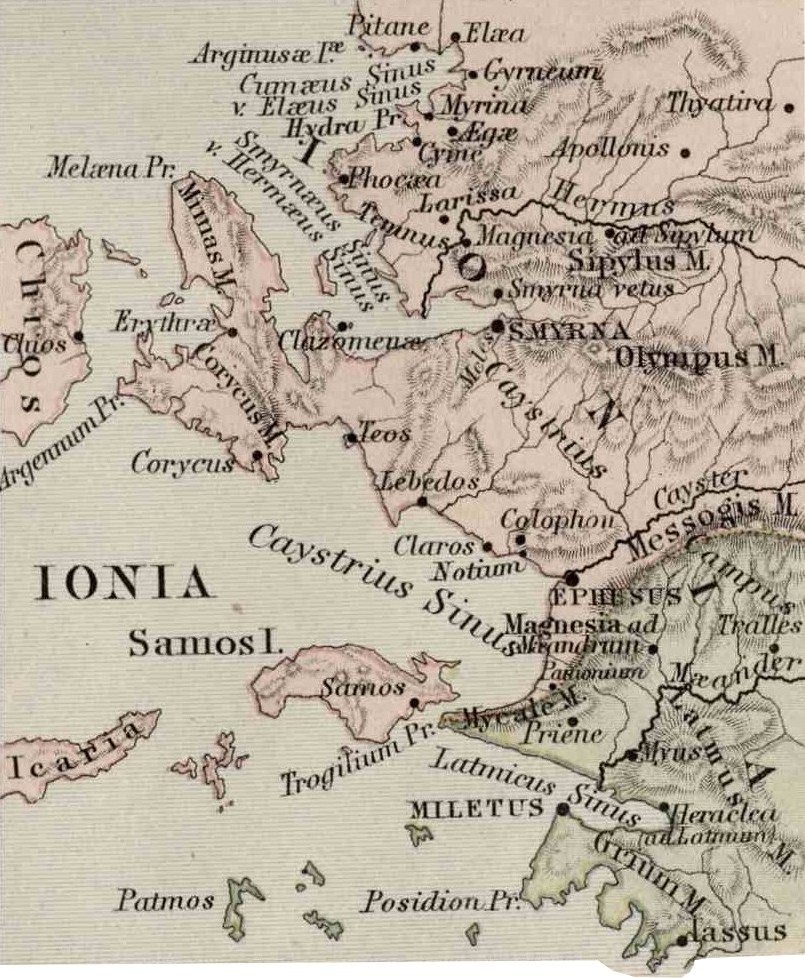
Myus (Ancient Greek: Μυοῦς), sometimes Myous or Myos, or Myes, was an ancient Greek city in Caria. It was one of thirteen major settlements of the Ionian League, and was one of three that spoke the same Ionic subdialect, the other two being Miletus and Priene. All three were Ionian colonies placed at the mouth of the Maeander River in the middle of the west coast of Anatolia.
Miletus was more ancient than the Ionians, having been occupied by various ethnic groups since the Neolithic. It was partly Hellenized in the Late Bronze Age by Achaeans, who are termed Mycenaeans in scholarly language. The previous inhabitants at that time were Anatolian language speakers, ancestors of the Carians. The Ionians secured it along with its multi-cultural population during the Submycenaean period between the Bronze Age and the Dark Age. If the re-colonization is the remote start of the Ionian League, Myus and Priene must have been in existence then, although there is no evidence that they were pre-Ionian.
Miletus appears in Homer; Myus does not. Perhaps it was after the heroic age. It does appear in the earliest known historian, Hecataeus of Miletus (550-476 BC), whose works survive only in fragments. He mentions Μύης (Myes). Subsequently the historians, Herodotus and Thucydides call it Μυοῦς. The ultimate authority probably should be the inscriptions, which refer to a city-ethnic, or name of the demos, as Μυήσιοι or Μυήσσιοι based on Μύης. These names are also abbreviated in coins minted by Myus.
Herodotus calls Myus a polis and its citizens politai, which means that it had a politeia, or constitution, and was considered an independent state, at least in its earlier times. It had a demos, which would have met in assembly, and a ruling council (boule). It struck its own coins.
Text adapted from
Wikipedia
under CC BY-SA 4.0.
Read more on Wikipedia →



 13 km
 15 km
 28 km
 29 km
 33 km